

TL;DR:
- Southwest design is a culturally rooted style inspired by Native American, Spanish Colonial, and Mexican traditions, specific to desert regions of the American Southwest. It emphasizes earth tones, natural materials, and geometric motifs with symbolic meanings, evolving toward restrained, authentic, and climate-responsive interiors. Authentic implementation involves focusing on structure, deliberate color choices, artisan pieces, layered textures, and respecting the cultural origins to create warm, timeless spaces.
Southwest design is one of the most misread styles in American interiors. Many people confuse it with generic rustic décor, cowboy themes, or a hodgepodge of Native American prints. The real meaning of southwest design goes much deeper. It’s a culturally grounded style shaped by centuries of Native American, Spanish Colonial, and Mexican folk art traditions, and it belongs to a specific geography: the desert cultures of Arizona, New Mexico, West Texas, and southern Colorado. Once you understand where it comes from, how it looks becomes far more meaningful.
Table of Contents
- Key takeaways
- The cultural origins of southwest design
- Visual and material elements that define the style
- Modern Southwest design: evolution and common misconceptions
- How to incorporate southwest design authentically
- Southwest design vs. similar styles
- My perspective on what makes Southwest design endure
- Bring authentic Southwest style into your home
- FAQ
Key takeaways
| Point | Details |
|---|---|
| Cultural roots define the style | Southwest design draws from Native American, Spanish Colonial, and Mexican folk art, not generic ranch or rustic themes. |
| Earth tones and natural materials are core | Terracotta, adobe, clay, leather, and handwoven textiles define the palette and texture of authentic Southwest interiors. |
| Geometric patterns carry real meaning | Motifs like the Squash Blossom and Naja symbol are rooted in spiritual significance and centuries of craft tradition. |
| Modern Southwest favors restraint | Today’s style leans toward muted, quiet palettes and sculptural simplicity rather than saturated colors and heavy clutter. |
| Authenticity beats themed décor | Layering a few genuine, artisan-made pieces creates far more impact than filling a room with mass-produced motifs. |
The cultural origins of southwest design
To understand southwest design style, you have to start with the land itself. This style did not emerge from a decorator’s sketchbook. It grew out of desert survival, community craft, and centuries of cultural exchange across the American Southwest.
The most foundational influence is Native American tradition, particularly the work of Navajo weavers and silversmiths. Navajo geometric patterns shaped the visual grammar of the entire style, with bold, angular compositions that were never purely decorative. Each pattern carried meaning, connecting the maker to nature, spirit, and community. The same is true of Pueblo pottery, where painted forms represented rain, growth, and the cycles of the natural world.
Spanish Colonial influence arrived with the missionaries and settlers who moved through the region beginning in the 16th century. They brought with them a tradition of adobe architecture, hand-troweled plaster walls, and heavy carved woodwork. Adobe walls were not just an aesthetic choice. They typically range 18 to 24 inches thick specifically for climate regulation, keeping interiors cool in summer and warm at night. That practical intelligence is baked into the design’s DNA.
Mexican folk art added a third layer, bringing handpainted tiles, wrought iron details, and richly textured textiles. These three traditions did not simply sit side by side. They merged organically over generations of trade, labor, and shared life across the region.
Here is what sets southwest design apart from its common lookalikes:
- Western style focuses on ranch life, cowboy iconography, and frontier nostalgia. Think horseshoes, spurs, and distressed leather in abundance.
- Boho style is globally eclectic and free-spirited, pulling from Moroccan, Indian, and various global craft traditions without geographic specificity.
- Rustic design centers on raw wood, log construction, and cabin aesthetics rooted in Northern and Midwestern landscapes.
Southwest design, by contrast, is geographically specific. It belongs to the desert. Its materials, colors, patterns, and spatial logic all reflect a particular climate and a particular set of cultural histories.
Pro Tip: When researching southwest design inspiration, look at the architecture first. Adobe construction, flat or low-pitched rooflines, and deep-set windows are the structural signals that everything else grows from.
Visual and material elements that define the style
The characteristics of southwest design are easy to recognize once you know what you are looking at. The style has a distinct palette, a recognizable material vocabulary, and a symbolic visual language that sets it apart immediately.
Color palette
Southwest design colors are drawn directly from the desert landscape. The dominant tones are warm and earthy.
- Terracotta and clay: The signature orange-red of fired earth and desert soil
- Warm brown and tan: Sand, adobe plaster, and dry grasses
- Dusty rose and rust: Subtle pink tones found in canyon stone and fading sunsets
- Sage green and muted olive: Desert plant life, particularly cacti and scrub brush
- Warm gray and cream: Bleached bone, dry riverbeds, and sun-faded plaster
Modern Southwest palettes in 2026 have shifted noticeably toward dusty rose, sage green, and warm gray, moving away from the saturated terracotta and teal combinations that defined the 1990s version of the style. The result is softer, more livable, and genuinely sophisticated.
Materials and textures
The material palette is just as telling as the colors. Authentic southwest interior design relies on:
- Adobe and clay: For walls, flooring, and pottery
- Rough-hewn and reclaimed wood: Ceiling vigas, furniture frames, and carved details
- Handwoven textiles: Wool rugs, blankets, and wall hangings rooted in Navajo weaving tradition
- Wrought iron: Light fixtures, hardware, and decorative grillwork
- Leather: Seating and upholstery in natural, undyed tones
- Stone and ceramic: Tile work, tableware, and sculptural objects
Texture is the real workhorse in this style. A well-executed Southwest room layers rough adobe against smooth leather, nubby woven textiles against polished stone. The interplay of surfaces creates warmth without the need for busy pattern or bright color.
Symbolic motifs and their meanings
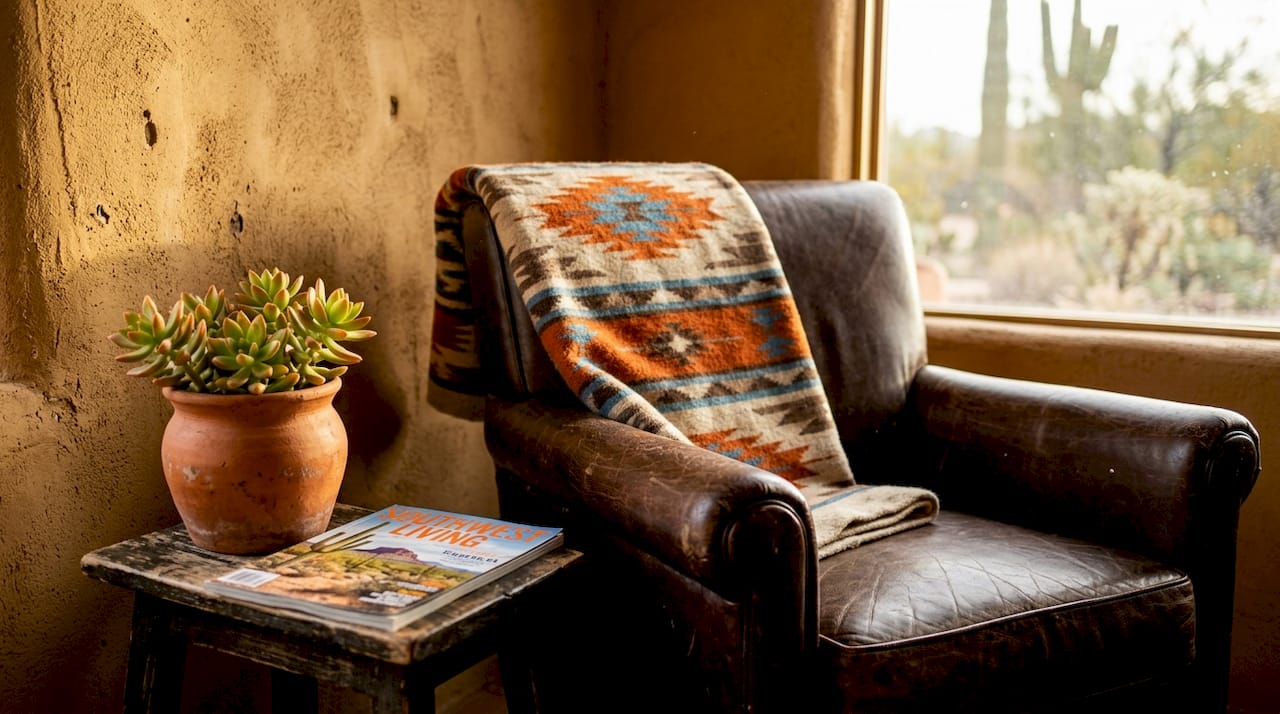
Southwest design patterns are not just decorative. Navajo cluster jewelry motifs, the Squash Blossom necklace form, and the Naja crescent shape each carry symbolic weight: spiritual harmony, abundance, and renewal. These motifs date to the 19th century silversmithing period when Native and Spanish craft traditions were actively merging.
The Squash Blossom, for example, represents fertility and growth. The Naja is a crescent shape with roots in both Spanish bridle ornaments and ancient protective symbolism. When you see these patterns translated into rug borders, tile work, or fabric prints, you are looking at a living design language with real cultural meaning.
| Motif | Origin | Symbolic meaning |
|---|---|---|
| Squash Blossom | Navajo / Pueblo | Fertility, abundance, growth |
| Naja crescent | Spanish and Native American | Protection, spiritual balance |
| Concha (shell shape) | Spanish Colonial | Beauty, completeness |
| Step and diamond geometry | Navajo weaving tradition | Water, mountains, the natural world |
| Kokopelli figure | Ancestral Puebloan | Fertility, harvest, music |
Pro Tip: If you want to incorporate southwest design patterns authentically, choose one or two primary motifs and let them repeat across different materials. A Naja shape in a rug, echoed in a pendant light or tile border, creates cohesion without visual overload.
Modern Southwest design: evolution and common misconceptions
Southwest design has gone through real changes since its last major wave of popularity in the 1990s, and those changes are worth understanding if you want to apply the style today.
The 1990s iteration was bold to a fault. Deep turquoise and heavy terracotta dominated every surface. Coyote sculptures appeared on mantels. Dream catchers hung in every doorway. The result often felt like a theme park rather than a home. That version gave the style a reputation it is still recovering from.
Modern Southwest design has moved decisively toward what designers now call “quiet luxury.” The palette is more restrained. The forms are cleaner. The emphasis has shifted to architectural simplicity and high-quality natural materials rather than decoration for decoration’s sake.
Here is what the current version of the style actually looks like:
- Walls in warm plaster tones: cream, oat, and soft adobe rather than saturated rust
- Furniture with sculptural, organic forms in natural linen, leather, or undyed wool
- One or two standout handcrafted pieces, such as a single Navajo-style rug or a hand-thrown ceramic vessel, rather than a room full of themed objects
- Strong indoor-outdoor connection through wide windows, shaded patios, and materials that flow from inside to outside
- Natural light treated as a design element, with deep-set windows and strategic shading that references traditional adobe construction
Southwest design is fundamentally climate-responsive, using architecture and materials to manage heat and light. Modern adaptations honor that logic by prioritizing airflow, shading, and natural temperature regulation in their design decisions.
The style is also experiencing a genuine resurgence in 2026, driven by fatigue with cold minimalism. People want spaces that feel warm, grounded, and alive. Southwest design delivers that without relying on trend-chasing.
How to incorporate southwest design authentically
Knowing what the style means is one thing. Putting it into practice without it looking themed or heavy is where most people get stuck. Here is a practical approach that works.
-
Start with structure and materials. Before you buy a single accessory, look at your floors, walls, and ceiling. Can you add warm plaster texture to a wall? Is there space for exposed wood beams overhead? Grounding the room in authentic materials creates a foundation that everything else will naturally build on. Experts recommend building room structure first, then layering texture and personality gradually.
-
Choose your palette deliberately. Commit to two or three core tones from the Southwest color family. Terracotta and warm gray work beautifully together. Sage green and cream feel fresh and current. Avoid using the full rainbow at once.
-
Invest in one or two genuine artisan pieces. A hand-knotted Navajo-style rug, a hand-thrown ceramic lamp base, or a piece of sterling silverwork with traditional motifs will do more for your room than twenty mass-produced Southwest-themed items. Authentic artisan pieces define the style. Mass-produced motifs dilute it.
-
Layer texture rather than pattern. Place a woven wool throw over a smooth leather sofa. Set a rough clay pot beside a polished wood surface. The contrast of textures is what gives Southwest rooms their characteristic warmth and depth.
-
Edit constantly. Designer Victoria Sass describes the ideal as a curated, evolved space rather than a perfectly staged one. A room that looks like it came together over years of thoughtful acquisition feels far more authentic than one assembled in a single shopping trip.
-
Respect the cultural origins. When purchasing textiles, pottery, or jewelry-inspired objects, seek out pieces made by Native American or Southwest artisans whenever possible. Sourcing with awareness honors the traditions that gave the style its meaning.
Common pitfalls to avoid:
- Overcrowding surfaces with too many small decorative objects
- Mixing in unrelated global or boho elements that dilute the desert aesthetic
- Using bright, saturated versions of Southwest colors that belong to the 1990s revival
- Buying mass-produced “Southwest-style” items with no connection to actual craft tradition
Pro Tip: Visit your local interior design showrooms or artisan markets before shopping online. Seeing the actual texture and weight of a handwoven textile or hand-thrown pot in person helps you make choices that will genuinely work in your space.
Southwest design vs. similar styles
Understanding the meaning of southwest design becomes even clearer when you compare it directly to the styles it is most often confused with.
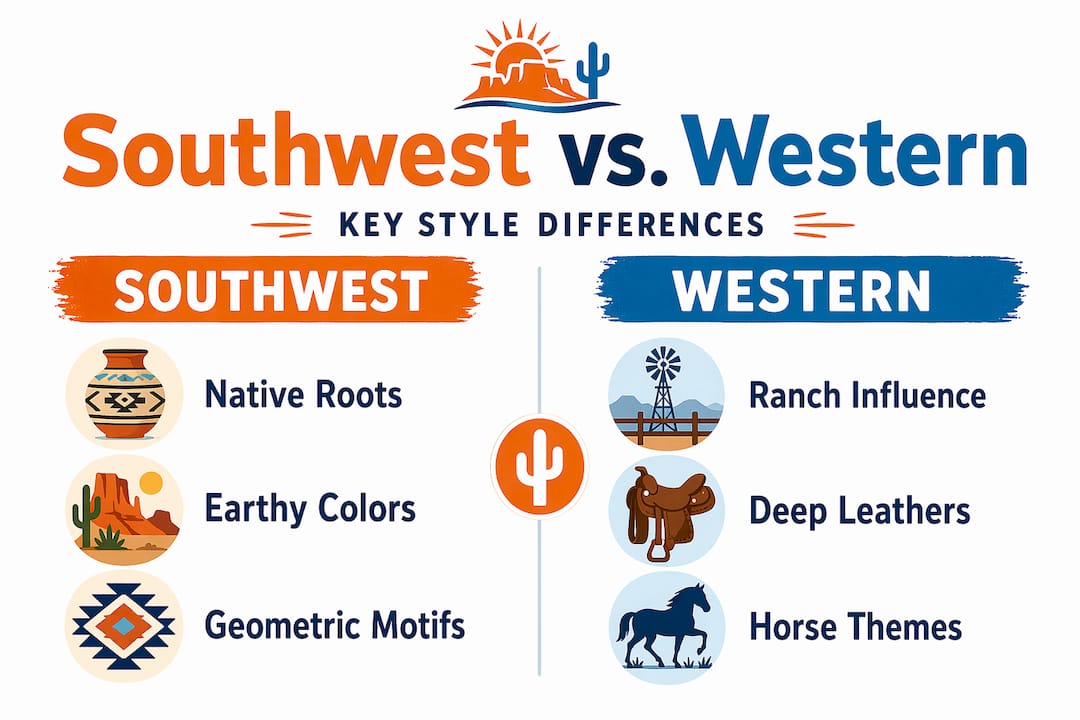
| Style | Core influence | Key materials | Signature motifs |
|---|---|---|---|
| Southwest | Native American, Spanish Colonial, Mexican | Adobe, clay, handwoven wool, leather | Geometric patterns, Squash Blossom, Naja |
| Western | American frontier and ranch culture | Distressed wood, cowhide, rough iron | Horseshoes, spurs, longhorn shapes |
| Boho | Global eclectic, no single origin | Macramé, mixed textiles, rattan | Free-form patterns, layered global prints |
| Rustic | Northern and Midwestern cabin life | Raw logs, rough-sawn wood, stone | Antlers, plaid, wildlife motifs |
Southwest design is distinct from Western and Boho styles precisely because of its strict geometric and cultural foundation. The patterns are not free-floating. They are rooted in specific traditions with specific meanings.
Here are the clearest signals that you are looking at authentic Southwest design rather than one of its neighbors:
- Adobe or plaster wall texture in warm, neutral tones
- Angular geometric patterns in textiles or tile work that reference Navajo or Zapotec weaving traditions
- Wrought iron hardware or lighting rather than antique brass or chrome
- Natural earth-tone colors without the barn red of Western style or the jewel tones of Boho
- Handcrafted ceramic or pottery pieces with visible craft marks rather than factory-smooth finishes
Southwest design’s deep cultural foundations give it a timeless quality that purely trend-driven styles cannot replicate. That grounding is exactly what makes it worth learning carefully.
My perspective on what makes Southwest design endure
I have spent a lot of time around Southwest-inspired spaces, and the thing that strikes me most consistently is how badly the style is represented when it is applied without any real understanding of what it means.
The version most people have seen, the one with dream catchers in every corner and turquoise paint on every cabinet, was never really authentic Southwest design. It was a 1990s commercial shorthand for the style. And it stuck around long enough to make serious designers wince.
What I find genuinely compelling about modern Southwest design is precisely the restraint it now demands. A single wool rug with a traditional geometric border on a warm plaster floor. A hand-thrown clay vase catching afternoon light from a deep-set window. These are not decorating shortcuts. They are choices that require you to slow down, look carefully, and understand what you are working with.
The cultural roots of this style are real, and they matter. The Navajo weaving tradition, the Spanish Colonial architecture, the Mexican folk art craft skills: these are not just aesthetic sources. They are living traditions practiced by real communities. When you engage with the style thoughtfully, you are participating in that history in a meaningful way.
My honest advice is this: start with fewer things, not more. The impulse to fill a room quickly always works against Southwest design. The spaces that do it best look like they were built slowly, with care, by someone who genuinely loves the desert and the cultures that shaped it.
— Trevor
Bring authentic Southwest style into your home
If this article has sparked some genuine excitement about bringing Southwest design into your own space, the next step is finding pieces that actually live up to the style’s standards.

At Arizonaswag, we celebrate the desert aesthetic in everything we create and curate. Our collections reflect the warm earth tones, bold geometric inspiration, and authentic Arizona spirit that define the Southwest at its best. Whether you are looking for Southwest home accents to anchor a room or wearable pieces that carry that desert energy into everyday life, you will find options built on genuine regional pride. Explore our collections at Arizonaswag and discover what it looks and feels like to live the Southwest style authentically.
FAQ
What is the meaning of southwest design?
Southwest design is a culturally rooted American interior style combining Native American, Spanish Colonial, and Mexican folk art traditions. It is specific to the desert regions of Arizona, New Mexico, West Texas, and southern Colorado, expressed through adobe architecture, earth-tone colors, geometric patterns, and handcrafted natural materials.
What colors define southwest interior design?
The core southwest design colors include terracotta, clay, warm brown, dusty rose, sage green, and warm gray. Modern interpretations favor muted, restrained versions of these tones rather than the saturated palette associated with 1990s Southwest décor.
How is southwest design different from Western style?
Southwest design draws from Native American weaving, Spanish Colonial architecture, and Mexican craft traditions, while Western style focuses on American frontier and ranch life iconography. Southwest patterns are strictly geometric and culturally symbolic; Western motifs center on cowboy and ranch life imagery.
What are the most recognizable southwest design patterns?
The most recognizable patterns are angular geometric forms rooted in Navajo weaving traditions, along with motifs like the Squash Blossom, Naja crescent, and concha shapes from Native American silversmithing. Each carries specific symbolic meanings related to abundance, protection, and spiritual harmony.
How do you incorporate southwest design without it looking clichéd?
Start with natural materials and warm plaster or adobe tones at the structural level, then layer in one or two authentic artisan pieces rather than filling the room with themed objects. Focus on texture contrast, a restrained color palette, and culturally significant items over mass-produced Southwest motifs.


