

TL;DR:
- True sustainability considers the full life cycle, including materials, durability, repairability, and end-of-life options.
- Multiple certifications and transparent data provide a more complete picture than relying on a single label.
- Regional supply chain decisions and consumer habits significantly influence a garment’s true environmental impact.
Picking up a shirt labeled “organic cotton” or “made from recycled bottles” feels like a win for the planet. But here’s the surprising reality: those labels alone tell you very little about an item’s true environmental impact. The full picture of sustainable apparel involves materials, manufacturing location, energy sources, care habits, end-of-life options, and much more. In this guide, we walk through the evidence-backed principles that actually define sustainable clothing, show you how to read between the lines of common claims, and connect those principles to the regional, desert-inspired apparel you love.
Table of Contents
- Defining sustainability in apparel: Beyond labels and materials
- Evidence and measurement: Understanding lifecycle assessment (LCA) in fashion
- Supply chain and regional impact: Materials, energy, and local pride
- Regulatory frameworks: How standards shape modern sustainable apparel
- Our take: What actually works in sustainable apparel (and where most guides fall short)
- Discover sustainable desert-inspired apparel with Arizona Swag
- Frequently asked questions
Key Takeaways
| Point | Details |
|---|---|
| Multi-factor sustainability | True sustainable apparel combines material choice, durability, repairability, recyclability, and supply chain transparency. |
| Evidence matters | Lifecycle assessment is complex; look for verifiable, context-driven impacts over simple labels. |
| Regional nuance | Local energy, production, and materials can shift sustainability outcomes more than raw material alone. |
| Regulations guide choices | Performance standards and digital product passports help consumers verify what makes apparel truly sustainable. |
| Be skeptical of labels | No label or certification can cover every sustainability aspect—always check for evidence and context. |
Defining sustainability in apparel: Beyond labels and materials
Now that we’ve challenged surface-level assumptions, let’s clarify what genuinely defines sustainability in clothing.
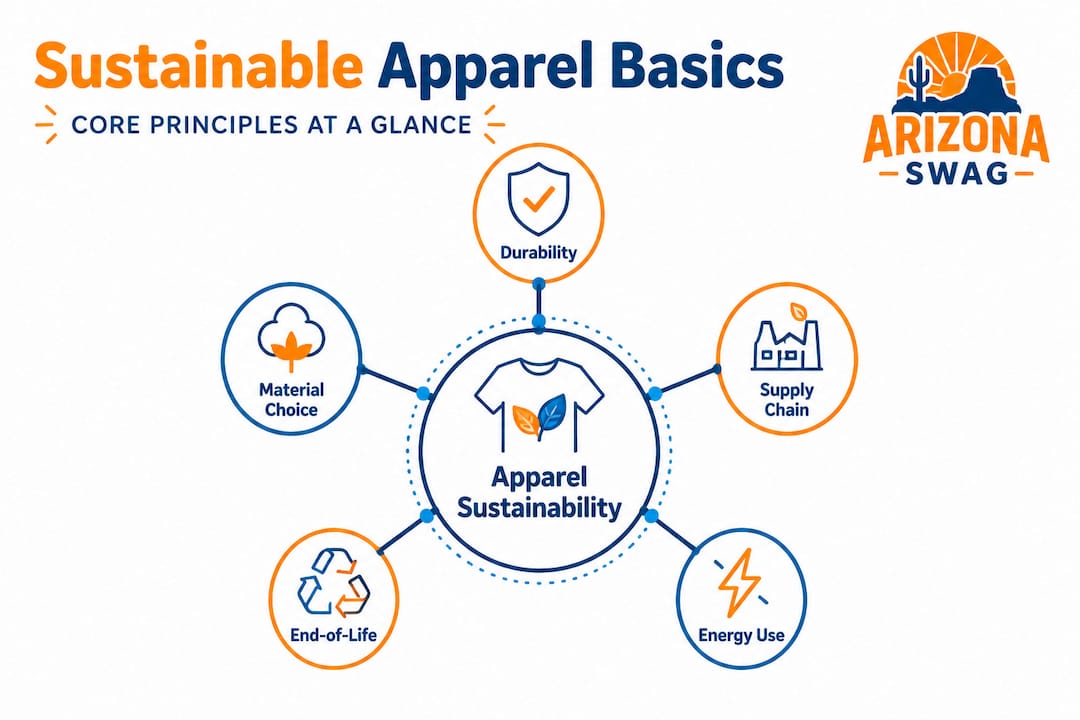
Sustainability in fashion is not a single checkbox. It is a set of overlapping principles that cover an item’s entire existence, from the field or factory where it starts, to the landfill or recycling bin where it ends. The most widely accepted framework for evaluating this is life-cycle thinking, which looks at every stage: raw material extraction, fiber processing, dyeing, manufacturing, transportation, consumer use, washing, and disposal.
According to design and sustainability researchers, apparel is sustainable when it is built around life-cycle thinking, covering materials, durability, repairability, recyclability, circularity, and reduced toxic chemicals, and supported by transparency such as labels or digital product passports. That is a much broader definition than “made with natural fibers.”
What life-cycle thinking actually covers
Here are the core areas that life-cycle thinking addresses in apparel:
- Materials: Are raw fibers grown, harvested, or synthesized in ways that minimize water, pesticide, and carbon use?
- Durability: Will the garment last three seasons or three years? Longer wear means fewer replacements and lower cumulative impact.
- Repairability: Can a torn seam or broken zipper be fixed easily, extending the item’s life?
- Recyclability and circularity: Can the fabric be recycled or composted at end of life, or does it head straight to a landfill?
- Toxic chemical reduction: Are dyes, finishes, and treatments safe for workers, wearers, and waterways?
- Transparency: Does the brand share information about where and how each piece was made?
Understanding premium apparel quality is closely tied to durability and construction standards, two factors that directly feed into life-cycle sustainability.

Why no single certification is enough
Dozens of certifications exist in the apparel space: GOTS, OEKO-TEX, Bluesign, Fair Trade, Recycled Content Standard, Cradle to Cradle, and many more. Each one measures something real and valuable. But no single label covers every dimension of life-cycle thinking. GOTS, for example, certifies organic fiber and responsible processing but does not measure carbon emissions from shipping. Recycled content standards verify material origin but say nothing about garment durability or repairability.
“Sustainability certifications are essential tools, but each one is a window into one part of a complex system. Relying on a single label is like judging a building’s safety by only checking the paint.” — paraphrased from ecodesign research in sustainable fashion methodology
Pro Tip: When evaluating a garment’s sustainability, look for multiple overlapping certifications or transparent supply chain data, rather than treating any one badge as the final word.
Comparing key sustainability criteria
| Criterion | What it addresses | Common limitation |
|---|---|---|
| Organic fiber certification | Pesticide and water use in farming | Does not cover energy or shipping impacts |
| Recycled content standard | Diverts waste from landfill | Does not assess durability or repairability |
| Fair Trade certification | Worker wages and conditions | Does not address environmental impacts |
| Cradle to Cradle | End-of-life recyclability | Complex scoring; not widely adopted |
| OEKO-TEX Standard 100 | Harmful substances in finished products | Does not address supply chain carbon |
| Digital product passport | Full supply chain transparency | Emerging; not yet universally required |
This comparison shows why you need to look at the combination of criteria rather than a single seal of approval.
Evidence and measurement: Understanding lifecycle assessment (LCA) in fashion
With the frameworks established, let’s look at how brands measure and sometimes misunderstand impacts.
Lifecycle assessment, commonly called LCA, is the primary scientific method used to quantify an apparel item’s environmental footprint across all its stages. An LCA assigns numerical values to impacts like carbon emissions, water consumption, land use, and chemical toxicity at each phase of a product’s life. It sounds precise, and it can be. But it comes with important limitations that every eco-conscious shopper should understand.
Sustainability claims in fashion often rely on lifecycle assessment, but comparability across brands and products is limited by persistent methodological inconsistencies in how studies are designed and what boundaries they set.
The steps of a basic apparel LCA
- Goal and scope definition: Decide what stages are included (farm to retail? farm to grave?) and what impact categories are measured.
- Inventory analysis: Collect data on energy, water, chemicals, and materials used at each stage.
- Impact assessment: Convert those inputs into standardized environmental impact scores.
- Interpretation: Draw conclusions and identify the stages with the biggest footprint.
- Peer review (optional but important): Independent experts check the methodology for bias or omissions.
The problem is that step one, defining scope, is where many inconsistencies enter. One brand might measure carbon from farm to retail store. Another includes the consumer washing phase, which can account for a surprisingly large share of a garment’s lifetime footprint. A third might exclude international shipping entirely. When you compare their numbers, you are not comparing the same thing.
How to read sustainability claims backed by LCA
When a brand says “our t-shirt has 50% lower carbon emissions,” ask:
- Lower than what baseline?
- Does the comparison include the same life stages?
- Was the LCA peer reviewed or self-reported?
- Does it account for consumer care (washing, drying)?
Brands producing thoughtful, transparent apparel, including unique graphic tees with clear design intent, are better positioned to share honest lifecycle information because they have visibility into their production choices from the start.
“An LCA is only as trustworthy as its assumptions. Two studies on the same product, using different boundary conditions, can reach dramatically different conclusions. Always look for the scope definition, not just the headline number.”
Key limitations in fashion LCA
The methodological inconsistencies researchers have identified include:
- System boundary differences: What life stages are in or out of scope
- Data quality variation: Industry averages versus brand-specific real data
- Allocation methods: How shared impacts (like a factory’s energy use) are distributed across products
- Impact category selection: Some studies focus only on carbon; others include water, biodiversity, and toxicity
- Consumer use assumptions: How often a garment is washed, at what temperature, and for how many years
These limitations do not make LCA useless. They mean you should treat it as a directional tool, not an exact measurement, and look for brands that are transparent about their methodology.
Supply chain and regional impact: Materials, energy, and local pride
Interpreting LCA is only one piece. Regional supply chains can radically shift what “sustainable” means in practice.
Two cotton t-shirts can look identical on a hanger but have vastly different environmental footprints based entirely on where and how they were made. Manufacturing and supply-chain decisions can materially change the footprint outcome, meaning that choosing a more sustainable raw material does not guarantee lower impacts when electricity mixes, logistics, and processing conditions differ by region.
This is one of the most counterintuitive insights in sustainable fashion. A shirt made from conventional cotton in a factory powered by renewable energy might have a lower carbon footprint than a shirt made from organic cotton in a region where coal powers the textile mills.
How location and energy mix change the math
The electricity grid powering a factory is a major variable. In regions where electricity comes mostly from coal or oil, energy-intensive processes like spinning, weaving, dyeing, and finishing carry a much heavier carbon burden. In regions with a higher share of wind, solar, or hydropower, those same processes produce far fewer emissions. Arizona’s abundant solar resources, for example, represent a real advantage for locally produced or finished goods compared to goods processed in coal-heavy regions.
Logistics matter too. Air freight generates roughly 50 times more carbon per kilogram than ocean shipping. A garment made from certified organic fibers but flown across multiple continents can easily exceed the footprint of a conventionally produced item shipped by sea or made close to home.
Desert aesthetics and sustainable material choices
Desert-inspired apparel, rooted in the colors, textures, and spirit of places like Arizona, naturally aligns with some sustainable material principles. Low-water fibers, earthy pigments derived from plants or minerals, and lightweight constructions suited to warm climates all fit the desert aesthetic. You can see how desert fashion fabrics reflect this practical relationship between environment and textile choice.
The key is that these connections must be evidence-backed, not just aesthetic. Labeling something “desert-inspired” does not automatically make it sustainable. But desert-inspired clothing that thoughtfully incorporates low-impact materials and regional production does carry genuine sustainability advantages. Examples of this principle in broader practice can be found in regionally adapted sustainable fashion movements around the world, where local materials and community production create genuinely lower-impact garments.
Questions to ask about regional sustainable apparel
Before buying a piece marketed as regionally sustainable, run through these questions:
- Where exactly are the fibers grown or sourced?
- What powers the factories where they are processed and assembled?
- How far does the finished garment travel to reach you?
- Does the brand share real data, or just general sustainability language?
- Are the production workers paid fairly and working in safe conditions?
- Is the product designed to last, or is it priced for disposability?
Pro Tip: A garment made closer to home, even from non-certified materials, can sometimes have a lower total footprint than a heavily certified product that crossed four continents before reaching your closet. Ask about logistics, not just materials.
Regulatory frameworks: How standards shape modern sustainable apparel
With local and global impacts in mind, let’s see how rules and standards help consumers verify sustainability claims.
Regulation is catching up to consumer demand for honest sustainability information. The most significant development globally is the European Union’s Ecodesign for Sustainable Products Regulation, known as ESPR. While it originates in Europe, its reach extends to any brand selling in European markets, including global fashion labels.
Regulatory frameworks like ESPR are increasingly translating sustainability concepts into measurable apparel performance criteria and transparency requirements, with digital product passports as a central tool.
What ESPR and similar regulations require
- Durability standards: Products must demonstrate minimum performance thresholds for fabric strength, color fastness, and seam durability.
- Repairability requirements: Brands must provide access to spare parts, repair instructions, or repair services for a defined period.
- Material efficiency: Regulations limit the use of hazardous substances and set minimum requirements for recycled content in certain product categories.
- End-of-life instructions: Consumers must receive clear guidance on how to dispose of or recycle a garment responsibly.
- Digital product passports: Each item carries a scannable code linking to verified information about materials, origin, certifications, and care instructions.
Digital product passports explained
A digital product passport is essentially a verified data record for a garment, accessible by scanning a QR code or NFC tag on the label. It can include fiber composition and origin, factory locations and certifications, carbon and water footprint data, care and repair guidance, and end-of-life recycling instructions.
This tool gives you, the consumer, the ability to check claims independently rather than relying on marketing language. It also creates accountability for brands, since inaccurate data in a passport can trigger regulatory consequences.
Understanding the difference between certification types
One important nuance that regulation helps clarify is the difference between three types of sustainability verification:
- Process standards: Certify how something is made (e.g., GOTS certifies organic farming and responsible processing practices)
- Product testing: Confirms that the finished item meets specific performance or safety thresholds (e.g., OEKO-TEX Standard 100 tests for harmful substances in the final product)
- Material certifications: Verify the origin or composition of fibers (e.g., Recycled Claim Standard confirms recycled content percentage)
A complete picture of a garment’s sustainability ideally draws on all three. Understanding certifications in apparel helps you identify which type of verification applies to any given label, and what gap it leaves.
For brands designing with function in mind, as explored in guides about practical design for desert apparel, meeting durability and material standards also happens to align with making garments that perform well in harsh conditions.
“Regulations like ESPR are not perfect, but they set a floor. They prevent the most misleading sustainability claims and give consumers a standardized basis for comparison. For conscious shoppers, a brand that meets these requirements is a safer starting point.”
Our take: What actually works in sustainable apparel (and where most guides fall short)
After surveying frameworks and regulations, here’s our deeper perspective on what consumers and brands often miss.
Most sustainability guides in fashion fall into one of two traps. They either present an oversimplified checklist (“buy organic, avoid fast fashion, done”) or they overwhelm you with so many certifications and LCA caveats that nothing feels actionable. Neither approach is honest about how complex and context-dependent sustainability actually is.
Here is what we genuinely believe, based on close attention to this space: the single biggest lever in sustainable apparel is not which certification you buy. It is how long you keep and care for what you own. A well-made garment, washed in cold water, air-dried, and worn for five years, will almost always outperform a certified “sustainable” item that falls apart after a year and ends up in a landfill.
This is not an excuse for brands to ignore material and production choices. Those matter enormously. But for consumers, habit and intention are often undervalued compared to the transaction itself.
We also believe that community-based, regionally adapted production deserves far more attention than it receives in mainstream sustainability discourse. When a brand sources, produces, and sells within a defined region, it creates shorter supply chains, more visible accountability, and a genuine connection between the product and the place it represents. That connection is not just emotional. It is often a meaningful sustainability advantage.
“Community-based production and local transparency are frequently the most honest forms of sustainable fashion, yet they rarely carry the certifications that dominate marketing. The absence of a label is not the same as the absence of care.”
The value of local streetwear benefits goes beyond regional pride. It represents a model where accountability, aesthetics, and community impact align without requiring a global certification body to validate the connection.
Our honest advice: prioritize habits over hype. Wash less frequently and at lower temperatures. Choose items made to last. Repair before replacing. Support brands that share real information about their supply chain, not just feel-good language. And give credit to regional producers who build genuine accountability into their process, even when they lack every certification that a larger brand can afford to purchase.
Discover sustainable desert-inspired apparel with Arizona Swag
To make sustainability actionable, here’s how regional options help you practice what you’ve learned.
You have spent time understanding what actually drives sustainability in apparel. Now you can put that knowledge to work. At Arizona Swag, we bring together bold desert-inspired designs, premium construction built for durability, and a genuine connection to Arizona’s landscape and culture. Every piece reflects the earthy terracotta tones, warm rust hues, and striking geometric patterns of the Southwest.

We are a family-owned business that believes in making things you will want to wear for years, not just seasons. From heavyweight graphic tees to cozy hoodies and distinctive hats, our collections are designed with staying power in mind. When you choose Arizona Swag, you are investing in apparel that carries regional meaning and is built to last. Browse our collections today and find pieces that represent where you come from and who you are.
Frequently asked questions
Does organic cotton always mean sustainable?
No. Organic cotton’s sustainability depends on regional supply-chain energy mix and logistics, not just the raw material itself. A factory powered by coal can offset the benefits of organic farming.
What should I look for in a sustainable apparel label?
Seek information on durability, repairability, recyclability, non-toxic materials, and transparent supply chain data. Genuinely sustainable apparel is designed with life-cycle thinking across all those dimensions, not just one.
Are desert-inspired clothes more sustainable?
Desert-inspired apparel can be sustainable when it uses low-water, locally adapted materials and verifiable production methods. The aesthetic alone does not guarantee environmental performance.
How can I verify the sustainability of regional or local apparel?
Check for supplier transparency, evidence-backed certifications, and digital product passports. Regulatory requirements like ESPR are making these verification tools more accessible and standardized for consumers worldwide.


